Beyond the Tennis Ball: What Does a VFX Reference Puppet Actually Do?

Why do physical puppets still have an important role in digital creature filmmaking?
When you think about creating CGI creatures, building a physical versions might seem slightly counterintuitive. After all, if the finished creature is going to be created digitally, why make a puppet that may never actually appear in the final shot?
The answer is that filmmaking still happens in a physical world. Actors need to know where a creature is. Cameras need to frame it. Performers may need to touch it, hold it or react to it. Lighting needs to behave convincingly around it. And sometimes an actor simply gives a better performance when there is another character standing in front of them rather than a marker at the end of a pole.
That is where VFX reference puppets come in.
At Stitches & Glue we've designed and built VFX reference and performance puppets for productions including:
Fantastic Beasts: The Secrets of Dumbledore
Mickey 17
Snow
White
Wonka
No Way Up and, most recently,
How to Train Your Dragon
The puppets have ranged from relatively simple stand-ins to large modular creature rigs and
expressive character puppets.
And although they may all broadly fall under the heading of 'VFX reference puppet', they
don't necessarily do the same job.
Giving actors something to perform with
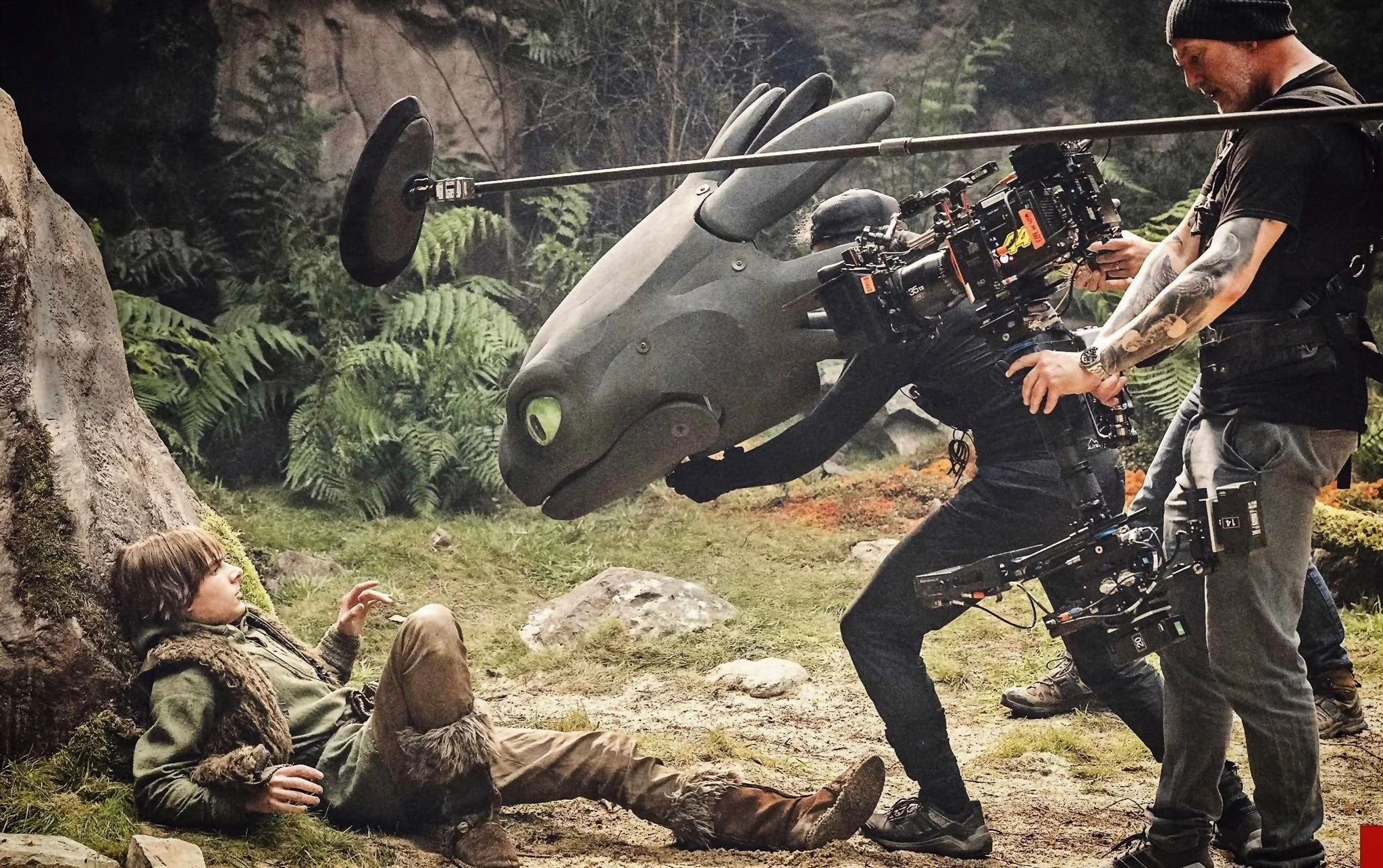
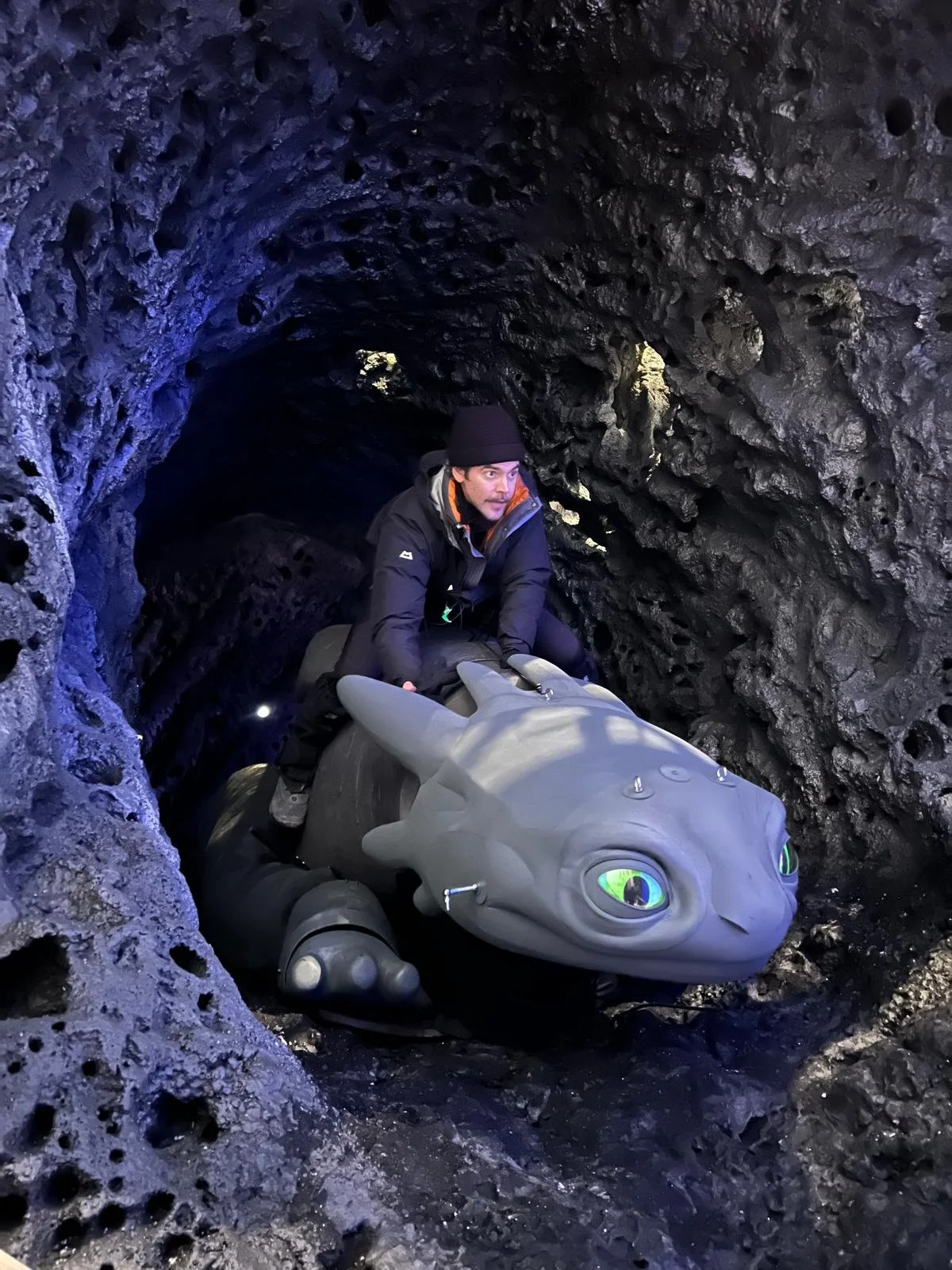
One of the most interesting examples is How to Train Your Dragon. The dragons in the finished film are digital characters created by Framestore, but physical versions of Toothless and several of the other dragons were also needed during filming. Working directly from Framestore's digital models, we created lightweight modular puppets that could represent the dragons physically on set. For Toothless this included a head, body, legs and tail, allowing Creature Puppetry Supervisor Tom Wilton and his team to establish both the character's position and his physical presence around the actors. But the Toothless head wasn't simply a marker showing where his head should be. His mouth could be operated. His ears could move. Different eye and eyelid shapes could be fitted depending on his emotional state. For the important scene in which Hiccup first encounters Toothless, we also created a dimensional eye that could be physically adjusted so that Toothless could look back at him.
The result was something much closer to a performance. Mason Thames wasn't simply being told where a digital dragon would eventually appear. Tom could perform Toothless opposite him - reacting to Mason, and allowing Mason to react in return. That interaction could then become reference for the animation team creating the finished digital Toothless.
Eyeline is only the beginning
The most obvious reason for putting a physical creature on set is eyeline. If an actor is supposed to be looking into the eyes of a dragon, somebody needs to establish exactly where those eyes are.
But a physical puppet can provide considerably more information than that. It establishes scale. It occupies space. It tells an actor how close they can get to a creature and how they might naturally move around it. And it gives the camera department something physical to compose within the frame.
On How to Train Your Dragon, the complete modular Toothless puppet helped establish the size of the character while giving the camera team a physical representation to frame around.
A very different example came on Fantastic Beasts: The Secrets of Dumbledore. For the Manticore sequence, Stitches & Glue created the creature's enormous stinger tail, operated on set by four puppeteers. It wasn't necessary to construct an entire practical Manticore. The tail provided the filmmakers with the physical scale and presence they needed for those particular shots.
Sometimes the most useful reference puppet isn't a complete creature at all.
Something you can actually touch
Physical interaction introduces another problem. It's one thing to look at an imaginary
creature. It's considerably harder to convincingly stroke one, grab one, wrestle with one
or have one push back.
With a puppet, the actor has something tangible to interact with. That was particularly
valuable with Toothless. The physical puppet allowed actors to make contact with the
character and gave the puppetry team something that could respond to that contact.
It becomes a two-way relationship.
And even though the puppet is ultimately replaced, those physical interactions
provide valuable information for the VFX and animation teams:
where a hand makes
contact
how an actor responds to apparent weight
how the body naturally moves
around a large animal
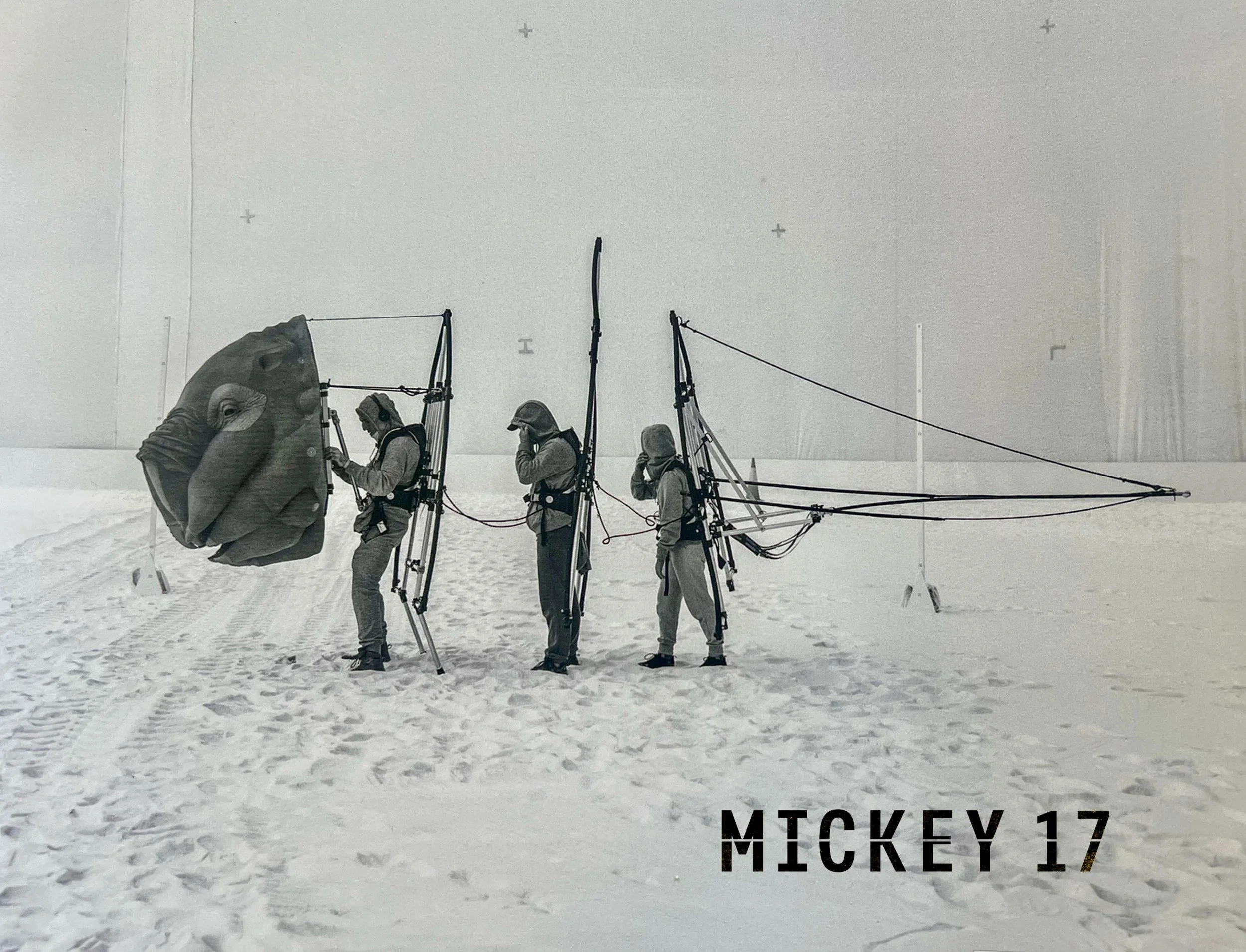
On Mickey 17, our work with the Creepers required several different approaches.
We built a large-scale modular Momma Creeper rig that could be operated by three puppeteers to establish the volume of the creature on set. At the other end of the scale were articulated Baby Creepers that could actually be held by members of the cast. Same film. Same creature family. Completely different physical requirements.
Helping the camera see something that isn't there
A CGI creature doesn't physically occupy the set, but the cinematographer still has to compose a shot as though it does. A reference puppet gives the camera department an immediate sense of the creature's volume and position. How much of the frame does it occupy? Where does its head enter the shot? How close is it to an actor? What happens to the composition when it moves?
This was another important function of the dragon puppets on How to Train Your Dragon. Production Animation Supervisor Glen McIntosh has spoken about the value of the physical Toothless not only for establishing the dragon's scale for the actors, but also for informing composition and framing. A foam creature that eventually disappears from the finished image can therefore have quite a profound influence on how that image is photographed.
You can read more in this BTS article in Befores & Afters by Ian Failes.
Lighting, shadows and the physical world
Sometimes a reference asset doesn't need to perform at all. Its job may be to tell the VFX
team something about light .
A physical form can provide real-world information about highlights, shadows, reflections
and how a creature interacts with the lighting conditions on set.
We've previously written about the value of lighting reference models, which are built
specifically to give VFX artists a physical representation of a digital character under real
lighting conditions.
But lighting information can also be incorporated into performance puppets.
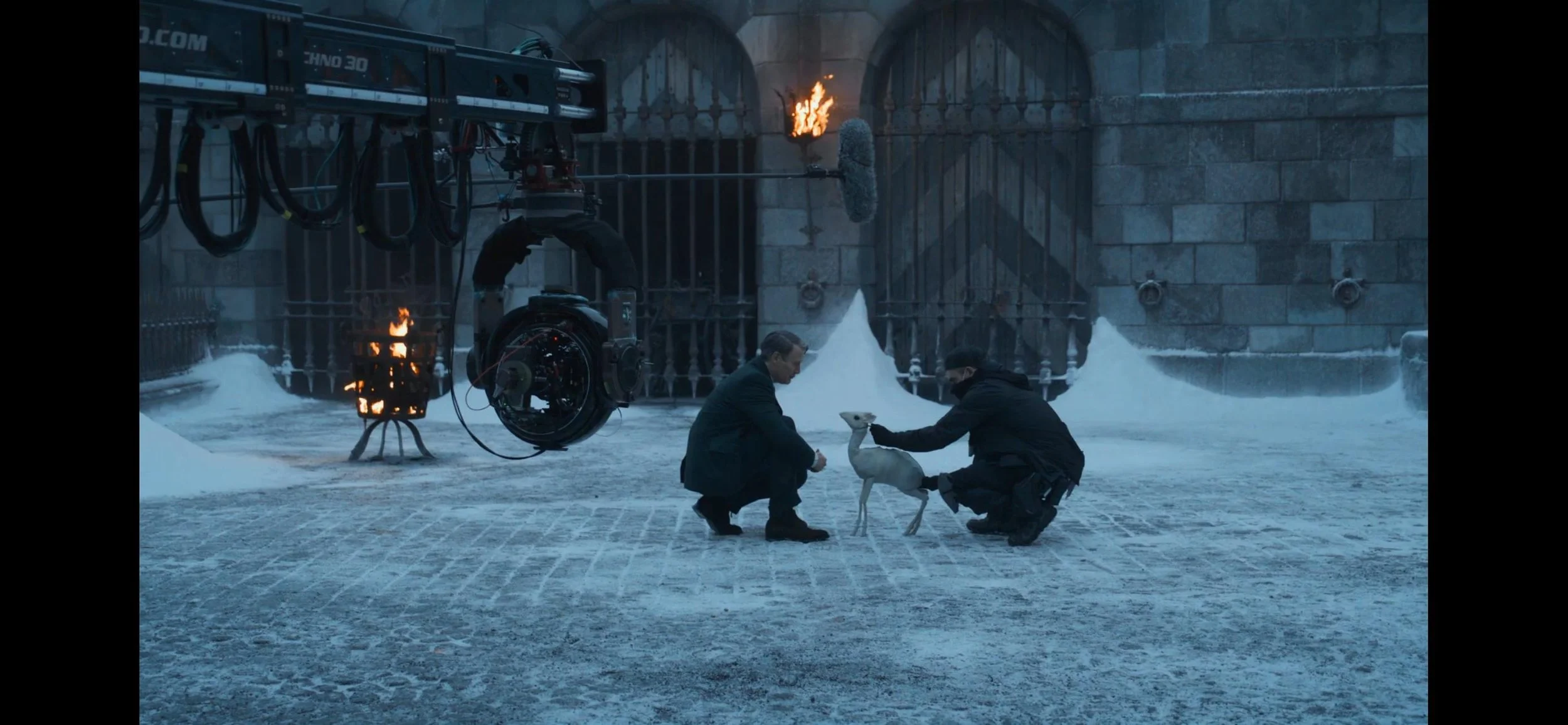
For Fantastic
Beasts: The Secrets of Dumbledore, the Qilin puppets incorporated controllable LEDs so
that interactive illumination could be created during filming.
For Mickey 17, meanwhile, one of the physical assets we created was a Juvenile Creeper
shadow-caster puppet.
Its purpose wasn't to become the creature seen on screen. Its purpose was to help create
something the creature would leave behind: its shadow.
These are good examples of why the word 'puppet' can be slightly misleading in a VFX
context. Sometimes we're creating a character. Sometimes we're creating a filmmaking
tool. Often we're creating a little of both.
Sometimes simple is better
It's tempting to assume that the more sophisticated the puppet, the more useful it must be. That's not necessarily true.
For the shark thriller No Way Up, for example, we produced a shark stand-in/stuffie for VFX reference. Its job was very different from an expressive Toothless head. And that's exactly the point. If a production principally needs scale, position, volume or eyeline, there may be absolutely no reason to add elaborate mechanisms that aren't required.
Likewise, How to Train Your Dragon itself used several levels of physical representation. Some creatures required performable heads. Others used backpack rigs. A Terrible Terror could be represented by different physical versions depending on what the shot required, including a simple form that an actor could hold.
The question shouldn't really be: "How sophisticated can we make this puppet?"
It should be: "What information does this shot need?"
Designing around the production
That question usually determines everything that follows.
Does the actor need to touch the creature?
Does it need to perform back?
Is it primarily
there for eyeline?
Does the camera need an accurate sense of its volume?
Does it need
to create interactive light or shadow?
Will puppeteers need to carry it through a difficult location?
Does it have to survive rain, wind, water or repeated stunt work?
One of our favourite examples of practical problem-solving came during How to Train Your Dragon.
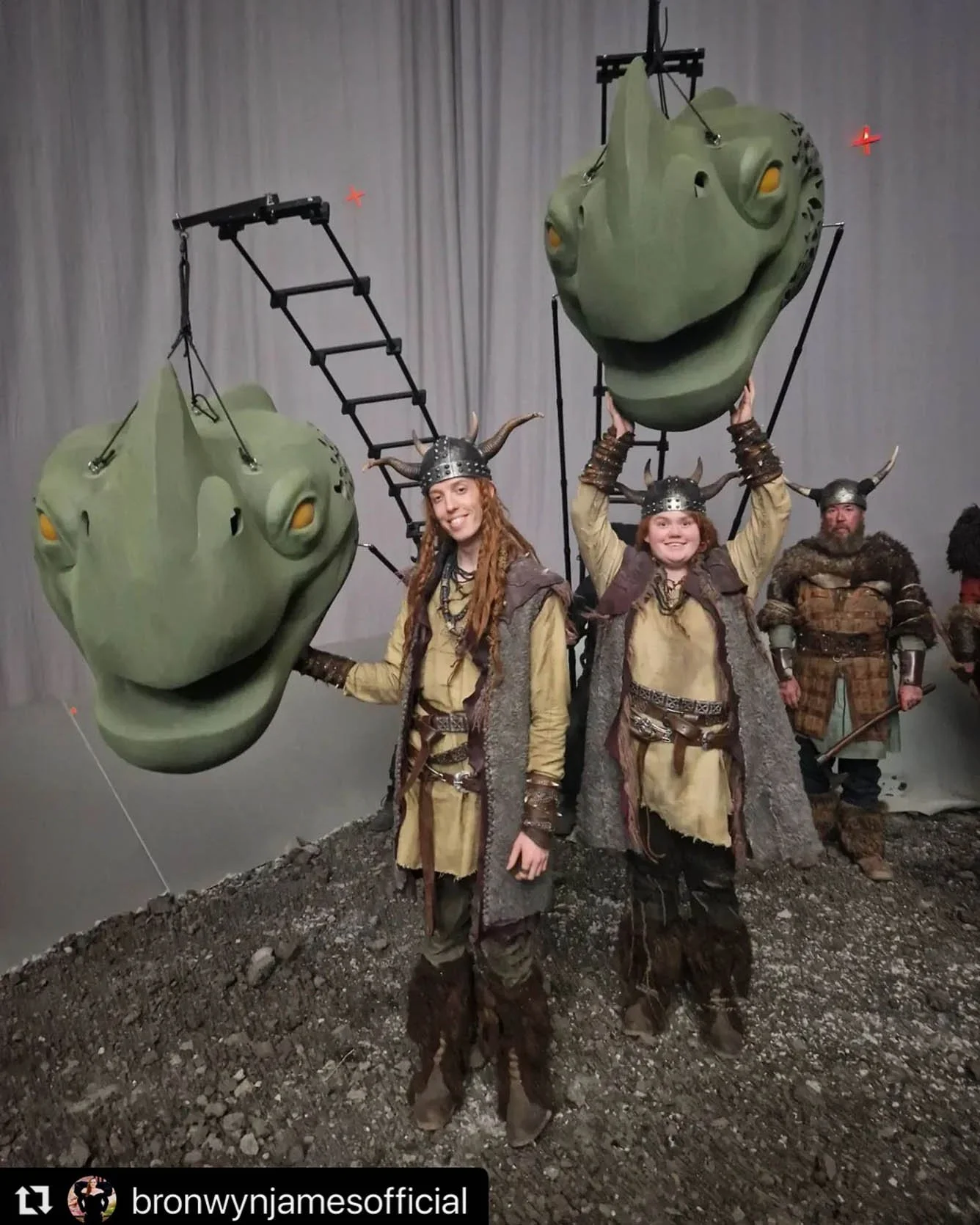
The Gronckle required a large lightweight foam head that could be puppeteered outdoors. Wind was an obvious problem, but so was rain. Water collecting inside a large foam puppet would quickly add unwanted weight.
Our solution was to incorporate a pattern of openings through the head, allowing wind and rain to pass through it.
The amusing part was that people assumed the pattern was there to suggest the Gronckle's scales. Sometimes a practical solution ends up becoming part of the design!
Practical and digital aren't opposites
Perhaps the most interesting thing about VFX reference puppetry is that it sits somewhere between two filmmaking traditions. The puppet is physical. The finished creature may be completely digital. But one doesn't have to compete with the other.
Framestore has described the on-set dragon puppetry on How to Train Your Dragon as providing valuable reference footage for its animators. The puppeteers themselves were simultaneously using Framestore's digital animation work to understand the dragons' intended poses and movement.
Digital informed practical. Practical informed digital. And the final character emerged from the conversation between the two.
That is increasingly how we think about this area of our work at Stitches & Glue. A VFX reference puppet doesn't have to be a finished practical creature waiting to appear on camera. It might be a fully performable character. It might be a head. A tail. A body volume. Something for an actor to hold. A lighting reference. Or even something whose only job is to cast the right shadow.
The starting question isn't: "What puppet should we build?"
It's: "What does the production need to know on set?"
And then we build the right thing to answer it.